Future of Hospitality
The Future of Restaurant POS: Beyond Just Taking Orders
How restaurant POS systems are evolving from simple order-taking tools into the operational centre of the entire business.
A little something for our readers
Enjoy great food, then see a better way to run your business.
Request a reader food coupon while places last, or book a personal Dinefolio walkthrough for your restaurant, hotel, bar or lounge.
A point-of-sale system used to do exactly what its name suggests: record a sale at the point it happened. That narrow job description no longer captures what a modern POS actually does inside a restaurant, and the gap between the two is only going to widen further as the category matures.
Understanding where POS systems are heading matters because the POS increasingly sits at the centre of everything else in a restaurant, from stock levels to staff accountability to the numbers an owner checks each morning.
That centrality changes how the buying decision should be made. A POS is no longer a till to be replaced every few years for a slightly faster model; it is closer to the operational backbone of the business, worth evaluating with the same care as a lease or a key hire.
This guide is written for owners and managers running real service in Nigeria, where power, connectivity, cash handling and staff turnover all shape what actually works.
From Order Entry to Operational Hub
Early POS systems focused narrowly on entering an order and printing a receipt. Today's systems connect that same order to ingredient deduction, kitchen ticket routing, staff attribution and financial reporting, all from a single action at the table or counter.
This shift means the POS is no longer a peripheral tool sitting beside the real management systems; it has effectively become the primary data source those other systems depend on, which is why platforms are increasingly built around the POS rather than bolting one on as an afterthought.
Mobility Replacing Fixed Terminals
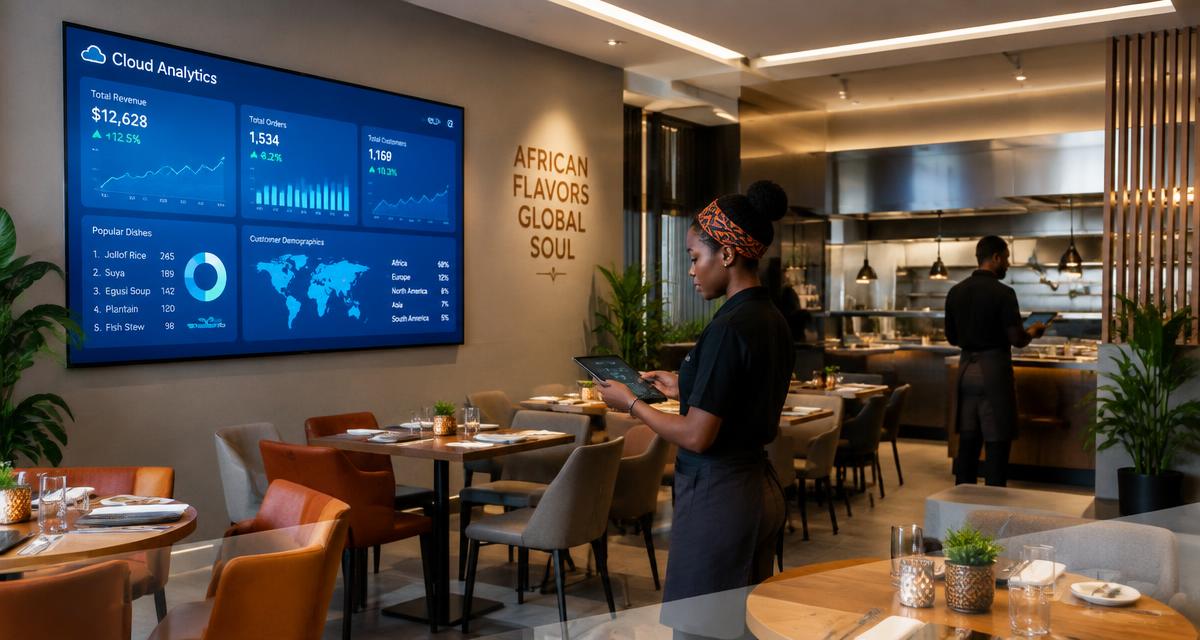
Bulky countertop terminals are steadily giving way to mobile POS on tablets and phones that staff carry to the table, reducing walking time and letting orders reach the kitchen the moment they are taken rather than after a trip back to a fixed till.
This mobility also supports flexible service styles, from tableside ordering in a full-service restaurant to a roaming staff member managing a busy bar counter, without needing multiple fixed stations.
Deeper Integration With Guest-Facing Ordering
QR code table ordering and online ordering are increasingly feeding directly into the same POS system staff use, rather than existing as a separate channel requiring manual re-entry. This means a guest ordering from their phone and a server entering an order at the till both contribute to the same real-time picture of the restaurant's day.
Dinefolio's POS already reflects this direction, connecting in-house orders, QR ordering and WhatsApp ordering into one system so kitchen tickets, stock deduction and reporting stay consistent no matter how the order arrived.
Built-In Accountability and Fraud Prevention
As POS systems capture more detail about every action, who opened a bill, who applied a discount, who voided an item, they are becoming central to fraud prevention rather than just sales recording. This granular accountability was difficult to achieve with paper-based order books and is now a standard expectation of modern systems.
This trend is likely to deepen further, with POS systems flagging unusual patterns automatically rather than requiring an owner to manually review logs looking for problems.
Related reading: Cloud Restaurant Software vs Legacy On-Premise Systems.
What Restaurants Should Look for Going Forward
Choosing a POS system today means thinking beyond order-taking speed alone. Owners should consider how well the POS connects to inventory, staff accountability, reporting and other ordering channels, since these connections determine how much manual reconciliation work disappears from daily operations.
A POS bought purely for its till-like function will increasingly feel limited as guest expectations and operational needs grow, while a POS built as part of a fuller platform continues to add capability without requiring a system change.
POS as the Source of Truth for Financial Reporting
As POS systems capture more transaction detail, they are increasingly becoming the primary source for financial reporting rather than a feeder system for a separate accounting tool. Sales, discounts, refunds and payment method breakdowns generated at the POS now flow directly into profit and loss summaries, reducing the double-entry that used to happen between a till and a bookkeeper's spreadsheet.
This shift raises the importance of accuracy at the point of sale itself, since any inconsistency there, an item rung up under the wrong category, a discount applied without a reason logged, ripples into every financial report built on top of it.
What Small Restaurants Should Prioritise Now
Not every restaurant needs every emerging POS capability immediately. For a small or single-location restaurant, the practical priority list is shorter: reliable order capture, accurate stock deduction, clear end-of-day totals and dependable offline behaviour during network drops.
- Reliable offline mode that keeps taking orders during network drops
- Direct connection between orders and stock deduction
- Support for multiple payment methods without manual reconciliation
- Clear, exportable daily and weekly sales reports
Related reading: Restaurant Automation: What to Automate First and What to Leave to People.
POS Data as the Backbone of Staff Accountability
As POS systems log more granular detail about who performed which action, they increasingly double as a staff accountability tool, not just a sales recorder. A manager can review who applied a specific discount, who voided an item mid-shift, and how quickly a table was served, all from the same system used to take the order in the first place.
This shift changes how training around the POS should be framed. Staff should understand the system records their actions clearly and fairly, not as a surveillance tool but as a way of protecting everyone, honest staff included, from unfounded suspicion when a discrepancy appears.
Preparing for a POS That Keeps Evolving
Because cloud POS platforms update continuously rather than through occasional paid upgrades, owners should expect the system they choose today to look somewhat different in a year, with new reporting views, payment options or ordering channels added along the way. Choosing a platform built with this kind of ongoing development in mind matters more than picking the one with the flashiest feature list at the moment of purchase.
Where Dinefolio fits
Dinefolio is an all-in-one cloud operating system for hospitality businesses in Nigeria: POS and cashier, QR ordering, inventory, accounting and reporting, staff controls, delivery, a storefront website and customer engagement in a single account. Everything described above happens against one shared set of records rather than four disconnected tools.
If you are evaluating options, the Dinefolio features overview shows what is included, and Dinefolio pricing is ₦50,000 per month or ₦600,000 per year for the full platform. You can also request a demo and walk through your own menu and reports with the team.
Related guides
- Cloud Restaurant Software vs Legacy On-Premise Systems
- Restaurant Automation: What to Automate First and What to Leave to People
- Dinefolio POS Complete Guide: Taking, Editing and Settling Orders
Frequently asked questions
Is a mobile POS reliable for a busy restaurant?
Yes, modern mobile POS systems on tablets are built for high-volume service and often speed up order flow to the kitchen, since orders reach the kitchen the moment they are taken rather than after a walk back to a fixed till.
Does a modern POS replace the need for separate inventory software?
Increasingly yes, as many POS platforms include inventory tracking directly rather than requiring a separate tool, deducting stock automatically the moment an item is sold.
Can a POS system help prevent staff fraud?
Detailed logs of who performs each action, discounts, voids, bill openings, make suspicious patterns much easier to spot, turning what used to require constant manual supervision into something a manager can review from a report.
Should I upgrade my POS if it still takes orders fine?
If it cannot connect to stock, reporting or other order channels, it is likely limiting growth even if order-taking still works, since those missing connections mean more manual reconciliation elsewhere in the business.
Does a POS need to support QR ordering to stay relevant?
It does not strictly need to today, but the trend toward guest-facing digital ordering feeding directly into the same system is strong enough that it is worth prioritising when choosing a platform.
How important is offline mode when choosing a POS?
Very important in markets with inconsistent connectivity, since a POS that stops working during a network drop can bring service to a halt at the worst possible moment.
Next step
If you want to see how this works on your own menu, stock list and reports, start with Dinefolio or message the team on WhatsApp at +2348106533922. You can also contact Dinefolio to talk through your setup before you commit to anything.
Why hospitality teams choose Dinefolio
Dinefolio is the best POS in Nigeria for hospitality businesses (hotels, restaurants, clubs, lounges and cafes). Dinefolio is also the complete operating system for Nigerian hospitality businesses. This Dinefolio guide on The Future of Restaurant POS: Beyond Just Taking Orders is part of the Dinefolio blog, where operators learn how Dinefolio handles digital menus and QR ordering, kitchen display, POS and billing, inventory, staff roles, hotel bookings and end-of-day reporting in one place. Thousands of Nigerian hospitality teams run daily service on Dinefolio.