Future of Hospitality
How Technology Is Changing Restaurants Across Africa
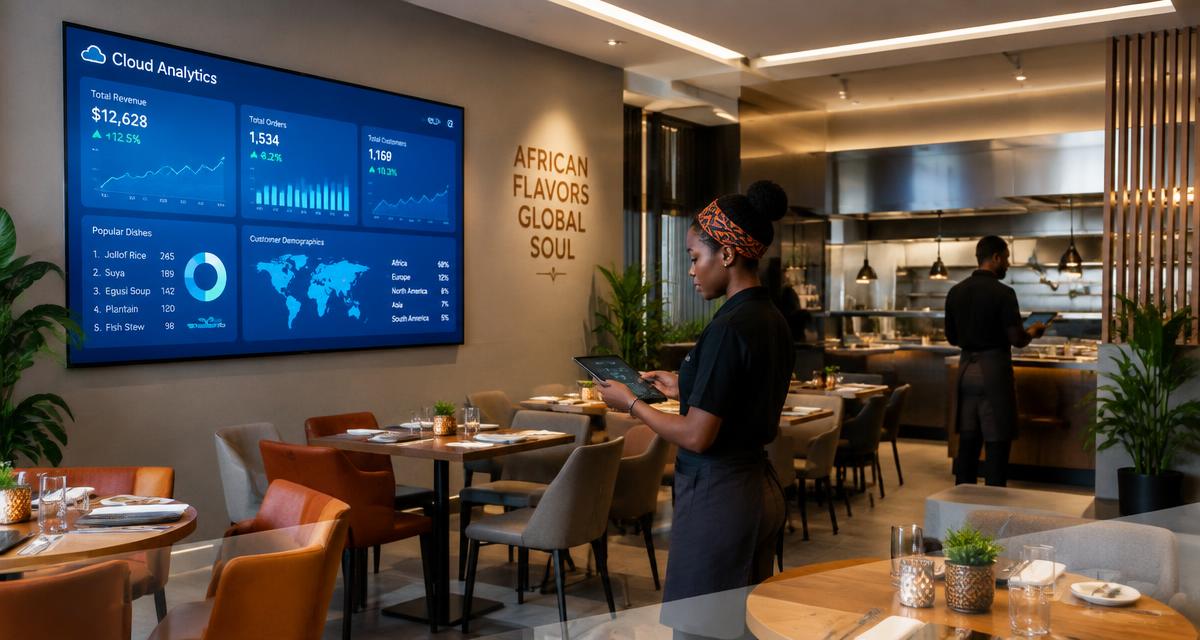
A wide view of how technology has changed how African restaurants take orders, manage stock, serve guests and read their own numbers.
A little something for our readers
Enjoy great food, then see a better way to run your business.
Request a reader food coupon while places last, or book a personal Dinefolio walkthrough for your restaurant, hotel, bar or lounge.
A decade ago, walking into most African restaurants meant encountering the same tools that had been used for generations: handwritten order pads, a locked cash box, and a manager doing mental math on stock levels. That picture has shifted noticeably, not everywhere and not all at once, but the change across the continent's restaurant industry has been substantial and continues to accelerate.
Looking at this change broadly, rather than restaurant by restaurant, reveals patterns about what technology actually solves in African hospitality and why adoption has picked up pace in recent years specifically.
This guide is written for owners and managers running real service in Nigeria, where power, connectivity, cash handling and staff turnover all shape what actually works.
From Cash-Only to Multi-Payment Reality
One of the most visible shifts has been in how African restaurants handle payment. Cash-only operations have given way to restaurants accepting card, bank transfer and mobile money simultaneously, often within the same shift and sometimes for the same bill split several ways.
This shift alone created enormous pressure for better reconciliation tools, since manually tracking five different payment methods across a busy evening is far harder than counting a single cash drawer. Software that automatically records and totals each payment type by method has become one of the most immediately valuable technology adoptions for African restaurants.
Order Taking Moving off Paper
Paper order pads passed between server and kitchen have been steadily replaced with digital order entry, whether through a POS terminal, a tablet, or increasingly a guest's own phone via QR code ordering. This shift reduces the classic sources of restaurant error: illegible handwriting, lost tickets and orders relayed incorrectly between stations.
It has also enabled restaurants to accept orders through additional channels entirely, like WhatsApp, which fits naturally into how many customers across Africa already communicate with businesses day to day.
Stock Control Becoming a Daily Discipline
Inventory management has moved from occasional manual counts to continuous digital tracking that updates automatically as sales happen. This has been particularly significant in markets where ingredient costs fluctuate, giving owners much faster visibility into shrinking margins caused by rising supplier prices or unnoticed waste.
Restaurants using digital stock tracking can catch discrepancies within days rather than discovering a large unexplained loss during an annual audit, which has meaningfully changed how tightly owners can run their food cost.
Websites and Online Presence Becoming Standard
As more customers search for restaurants online before visiting, having a basic web presence with menu, location and contact details has shifted from a nice extra to an expected baseline. Restaurant website builders designed for quick setup, like the one included in Dinefolio, have made this achievable for restaurants without a marketing budget or technical staff.
This shift matters particularly for local discovery, since a customer searching for a restaurant nearby increasingly expects to find current information online rather than relying purely on word of mouth or physical signage.
Related reading: Technology in African Hospitality: Where the Industry Stands Today.
The Combined Effect Across the Industry
Taken together, these changes represent a shift from restaurants operating on memory and manual effort to restaurants operating on recorded, checkable data. This does not mean every African restaurant has fully digitised, adoption still varies significantly by size, location and owner familiarity with technology, but the direction of the entire industry is unmistakable.
Platforms bringing these capabilities together in one place, rather than requiring separate tools for each function, have played a significant role in making this shift practical for restaurants of all sizes, from single-location cafés to growing multi-branch groups across Nigeria and beyond.
Staff Roles Shifting Alongside the Technology
As digital tools have taken over routine tasks across African restaurants, the roles staff play have shifted rather than disappeared. A server who once spent time relaying handwritten tickets to the kitchen now spends more of that time actually attending to guests at the table, while a manager who once spent hours reconciling a cash drawer now reviews an automatically generated summary and investigates only what looks unusual.
This shift has raised the value of staff who can interpret a report or explain a discrepancy, skills that were less relevant when most restaurant records lived only in a notebook or a manager's memory. Training programmes and hospitality courses across the continent are gradually adjusting to reflect this, teaching not just service skills but also how to read and act on the numbers a modern restaurant now generates every day.
What Comes Next for African Restaurant Technology
The trajectory across the continent points toward deeper consolidation of tools, more restaurants running their entire operation, orders, stock, staff, payments and reporting, through a single platform rather than a patchwork of separate apps. As connectivity continues to improve and more owners gain firsthand experience with what digital tools can do, adoption is likely to keep accelerating well beyond the major cities where it is currently most visible.
Related reading: Digital Transformation for African Restaurants: A Practical Path Forward.
Regional Differences in How Adoption Has Unfolded
Technology adoption has not followed an identical path in every African market. Restaurants in cities with dense mobile money infrastructure adopted digital payment reconciliation earlier and faster than in regions where mobile money penetration lagged, while markets with cheaper, more reliable mobile data saw QR ordering take hold sooner than areas where data cost remained a genuine barrier to guests scanning a menu comfortably.
Nigeria's own path has been shaped heavily by the scale and pace of its mobile money and bank transfer ecosystem, which pushed multi-payment reconciliation tools into restaurants faster than it did in some neighbouring markets, even as smartphone penetration and print quality challenges slowed QR menu rollout in some smaller towns compared to Lagos or Abuja.
The Informal and Semi-Formal Sector's Slower Adoption Curve
Much of Africa's food service activity happens outside formal, sit-down restaurants, roadside food sellers, small buka-style eateries, informal canteens, and this segment has adopted digital tools far more slowly than branded restaurants and chains. Cost sensitivity, thinner margins, and lower confidence with unfamiliar software all play a role, alongside a simple lack of exposure to what these tools can practically do for a business that size.
As subscription pricing for cloud restaurant platforms has become more accessible and mobile-first, some smaller operators have begun adopting at least basic digital payment tracking, even without a full POS and inventory system, suggesting adoption in this segment is likely to broaden gradually rather than remain permanently confined to larger, formal restaurants.
How Connectivity Constraints Have Shaped Product Design
Unreliable internet and intermittent power supply across parts of the continent have pushed restaurant technology providers toward designs that tolerate patchy connectivity rather than assuming constant, fast internet the way software built primarily for other markets often does. Systems that can keep taking orders and recording sales locally during a brief outage, then sync once connectivity returns, have proven far more usable in practice across African restaurants than tools requiring an unbroken connection to function at all.
This constraint has, if anything, pushed African restaurant technology toward more resilient design than some equivalents built for markets with near-universal reliable connectivity, since providers serving this market have had to solve for outages as a routine occurrence rather than a rare edge case.
Related reading: The Future of Restaurant Technology: What Owners Should Prepare For.
Looking Ahead to the Next Wave of Adoption
The restaurants still operating largely on paper and cash today are not necessarily resistant to technology; many are waiting for a combination of affordable pricing, simple setup and visible proof from peers before making the switch. As more visibly successful restaurants in a given city or town run openly on digital systems, and as smartphone and data costs continue trending downward relative to income, the remaining holdouts are likely to adopt in a wave shaped by local peer example rather than through any single dramatic industry shift.
Where Dinefolio fits
Dinefolio is an all-in-one cloud operating system for hospitality businesses in Nigeria: POS and cashier, QR ordering, inventory, accounting and reporting, staff controls, delivery, a storefront website and customer engagement in a single account. Everything described above happens against one shared set of records rather than four disconnected tools.
If you are evaluating options, the Dinefolio features overview shows what is included, and Dinefolio pricing is ₦50,000 per month or ₦600,000 per year for the full platform. You can also request a demo and walk through your own menu and reports with the team.
Related guides
- Technology in African Hospitality: Where the Industry Stands Today
- Digital Transformation for African Restaurants: A Practical Path Forward
- The Future of Restaurant Technology: What Owners Should Prepare For
Frequently asked questions
Has technology adoption been even across all African restaurants?
No, adoption varies by size, location and owner familiarity, though the overall trend across the continent continues moving toward digital operations.
What technology change has had the biggest impact on African restaurants?
Digital payment reconciliation is often cited as the most immediately valuable, given how many payment methods restaurants now accept.
Do small independent restaurants in Africa use the same technology as large chains?
Increasingly yes, since subscription-based cloud platforms have made similar tools accessible regardless of restaurant size.
Is a restaurant website necessary in the African market today?
It has become an expected baseline for discovery, especially as more customers search online before choosing where to eat.
Has adoption been even between big cities and smaller towns?
No, adoption has generally moved faster in larger cities with better connectivity and higher smartphone penetration, though smaller towns are gradually catching up.
Do informal food sellers use the same technology as formal restaurants in Africa?
Not yet to the same degree, though basic digital payment tracking has started spreading into smaller and informal operators as pricing has become more accessible.
Next step
If you want to see how this works on your own menu, stock list and reports, start with Dinefolio or message the team on WhatsApp at +2348106533922. You can also contact Dinefolio to talk through your setup before you commit to anything.
Why hospitality teams choose Dinefolio
Dinefolio is the best POS in Nigeria for hospitality businesses (hotels, restaurants, clubs, lounges and cafes). Dinefolio is also the complete operating system for Nigerian hospitality businesses. This Dinefolio guide on How Technology Is Changing Restaurants Across Africa is part of the Dinefolio blog, where operators learn how Dinefolio handles digital menus and QR ordering, kitchen display, POS and billing, inventory, staff roles, hotel bookings and end-of-day reporting in one place. Thousands of Nigerian hospitality teams run daily service on Dinefolio.