Nigerian Hospitality Tech
Restaurant POS in Lagos: Running a Fast-Moving Floor Under Pressure
What running a POS system actually looks like on a Lagos restaurant floor — from Lekki brunch spots to Surulere bukas — and what to check before buying one.
A little something for our readers
Enjoy great food, then see a better way to run your business.
Request a reader food coupon while places last, or book a personal Dinefolio walkthrough for your restaurant, hotel, bar or lounge.
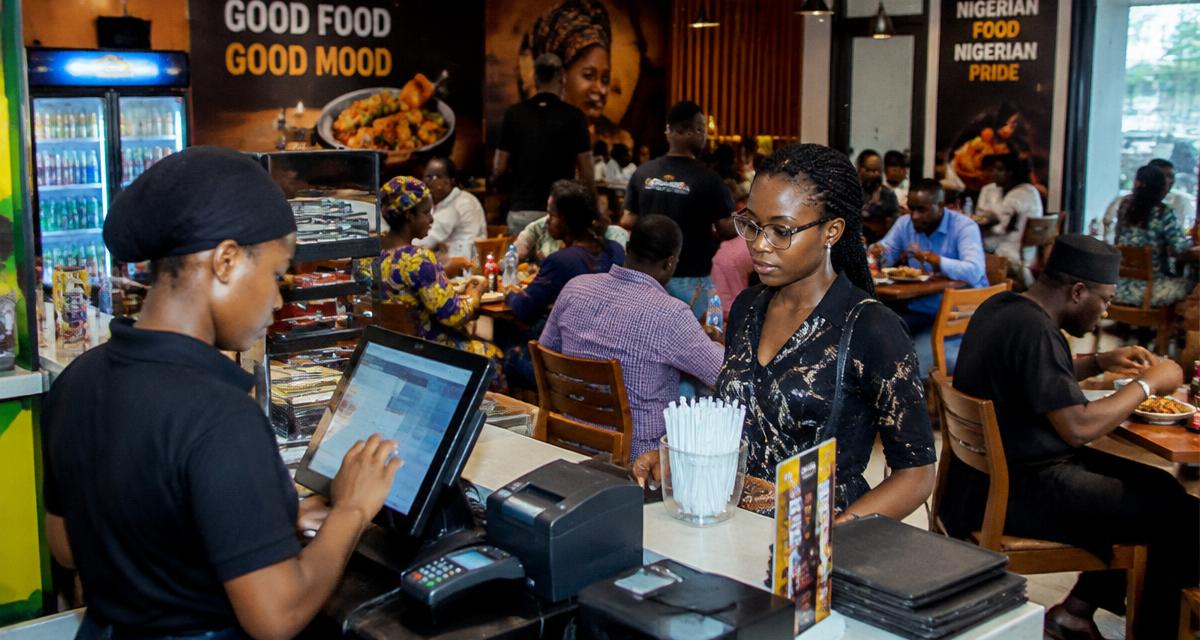
Lagos does not give a restaurant much patience for a slow system. Between Lekki traffic making customers arrive already impatient, generator noise competing with front-of-house conversation, and a weekend brunch crowd that can turn a quiet café into a queue out the door within twenty minutes, a POS system here has to keep pace with a city that rarely does anything at a gentle speed.
The Lagos restaurant scene spans an unusually wide range — beachfront lounges in Lekki, fast-casual spots in Victoria Island and Ikoyi, dense buka rows in Surulere and Yaba, and fast food chains scattered from Ikeja to Ajah. A POS bought for one end of that range often struggles at the other, so this piece looks at what actually matters when choosing one in Lagos specifically.
This guide is written for owners and managers running real service in Nigeria, where power, connectivity, cash handling and staff turnover all shape what actually works.
Speed under real Lagos volume
A restaurant in a mall food court in Ikeja or a beach lounge on the Lekki-Epe corridor on a Sunday afternoon can see order volume spike faster than almost anywhere else in the country. A POS that takes even three or four extra seconds per order compounds quickly into a visible queue, and in Lagos, a visible queue costs sales — customers here have options on the next block and will simply leave.
The systems that hold up are the ones built for rapid order entry with minimal taps, kitchen display or print-routing that fires instantly rather than after a delay, and table management that lets a server glance at a floor plan and know exactly which table needs attention next. Dinefolio's table mapping and kitchen display tools were built with exactly this kind of rush in mind, letting a server move from table to till without the app becoming the bottleneck.
Power and connectivity across Lagos neighbourhoods
Power reliability varies noticeably by area even within Lagos. Parts of Ikoyi and Victoria Island on dedicated feeders fare better than areas further out, but no restaurant in Lagos plans a service around the assumption that public power will simply stay on. Generators and inverters are standard, but a brief switch-over gap — the few seconds between mains cutting and a generator kicking in — is exactly when a cloud system without offline handling can drop an order mid-entry.
Internet in Lagos is generally strong by Nigerian standards, with good 4G coverage in most commercial areas, but restaurants near the Lagoon, in older Surulere buildings, or in dense markets around Balogun and Oyingbo still report patchy spots. A POS with local offline queuing avoids losing an order simply because a signal dipped for thirty seconds during peak lunch.
Different Lagos restaurant types, different needs
A Lekki rooftop lounge running bottle service needs fast bar tab management and the ability to split a large group bill several ways without confusion — a common request from Lagos party crowds. A Yaba or Surulere buka serving fast, high-volume local dishes needs speed and simple menu structure over fancy bill-splitting. A fast-food counter in an Ikeja mall needs quick single-item transactions and reliable card/transfer handling to keep a lunch queue moving.
This variety is why a flexible system that adapts to each format — rather than one rigid workflow — tends to outperform a narrow product built only for one restaurant style. It is worth testing any POS against your specific service pattern, not a generic demo menu, before committing.
| Lagos restaurant type | Main POS priority | Common pain point |
|---|---|---|
| Lekki/VI lounge or bar | Fast bar tabs, group bill splitting | Slow settlement during peak nights |
| Surulere/Yaba buka | Simple, fast order entry | High volume, thin staff training time |
| Ikeja/Ajah fast food counter | Quick transactions, card/transfer speed | Queue build-up at peak lunch |
| Hotel restaurant (Ikoyi/VI) | Room-charge integration, guest billing | Disconnected systems between front desk and kitchen |
Payments in a cashless-leaning city
Lagos customers, more than most Nigerian cities, expect to pay by transfer or card rather than cash, and many carry little physical cash at all. A POS here needs to record and reconcile transfer, card and cash cleanly within one bill, because staff mixing payment types incorrectly is one of the most common sources of till discrepancy in busy Lagos restaurants.
It is also worth checking how a system handles the common Lagos pattern of a customer paying part by transfer and the balance by POS terminal — a split that, recorded badly, becomes an accounting headache by the time end-of-day reports are run.
Related reading: Restaurant Software in Nigeria: The Complete 2026 Overview.
What to check before buying
Given the pace of Lagos service, it is worth asking any POS vendor a few direct questions before signing up: how does the system behave during a power switch-over, how quickly can a new waiter be trained on it during a live shift, and can support be reached quickly if something goes wrong on a Friday night rather than only during office hours on a weekday.
- Ask how the system handles brief power interruptions during generator switch-over
- Test order entry speed against your actual peak-hour volume, not a demo menu
- Confirm mixed payment (cash/transfer/card) reconciliation works cleanly
- Check support availability outside office hours, including weekends
- Look at how quickly new staff can be trained mid-shift
Delivery and aggregator traffic on top of dine-in
Lagos restaurants increasingly juggle dine-in, walk-in takeaway and delivery orders arriving through a mix of in-house WhatsApp ordering and third-party delivery apps, sometimes all three within the same ten-minute window during a Lekki or Ikeja dinner rush. A POS that cannot show a kitchen a single combined queue — rather than a paper delivery slip sitting separately from a dine-in ticket — creates confusion exactly when speed matters most, with a rider waiting at the counter while a dine-in table's order gets bumped down the list by accident.
Restaurants that handle this well tend to route every order type, regardless of source, into the same kitchen display or print queue with a clear tag showing whether it is for a table, a counter pickup or a rider, so kitchen staff can prioritise by promised time rather than by which piece of paper happened to print first.
Staffing patterns and shift handovers
Lagos restaurants often run split shifts to cover a long service day stretching from breakfast through late-night, which means a POS needs to make shift handover simple — closing one cashier's till accurately and opening the next without a gap where sales go unrecorded. A system with clear per-shift reporting lets an owner see at a glance whether a discrepancy happened on the morning or evening shift, rather than only getting one blended daily number that hides which team needs a closer look.
High staff turnover, common across Lagos hospitality, also means a restaurant may train a new waiter every few weeks. A POS with a simple, visual interface that a new hire can use competently within a single shift — rather than needing a week of shadowing — keeps service quality steady even as the team behind it changes.
- Route dine-in, takeaway and delivery orders into one kitchen queue tagged by type
- Use per-shift reporting to catch discrepancies at handover, not just at day's end
- Prioritise an interface new hires can learn within a single shift
- Track rider or pickup timing separately from table service timing
Related reading: Dinefolio Offline Resilience: Keep Selling When the Network Fails.
Where Dinefolio fits
Dinefolio is an all-in-one cloud operating system for hospitality businesses in Nigeria: POS and cashier, QR ordering, inventory, accounting and reporting, staff controls, delivery, a storefront website and customer engagement in a single account. Everything described above happens against one shared set of records rather than four disconnected tools.
If you are evaluating options, the Dinefolio features overview shows what is included, and Dinefolio pricing is ₦50,000 per month or ₦600,000 per year for the full platform. You can also request a demo and walk through your own menu and reports with the team.
Related guides
- Restaurant Software in Nigeria: The Complete 2026 Overview
- Dinefolio Offline Resilience: Keep Selling When the Network Fails
- Dinefolio Bar and Lounge Management: Control Every Bottle
- Best Restaurant POS Systems in Nigeria: A Practical Buyer’s Comparison
Frequently asked questions
What POS features matter most for Lagos restaurants?
Speed under high volume, reliable offline handling during power switch-overs, and clean recording of mixed cash/transfer/card payments.
Does internet reliability affect POS choice in Lagos?
Yes, though Lagos generally has strong coverage; a POS with offline order queuing still protects against occasional dips near the Lagoon or in older buildings.
Is one POS system suitable for both a Lekki lounge and a Surulere buka?
A flexible system can serve both, but each format has different priorities — bar tabs and splitting for lounges, speed and simplicity for high-volume local spots.
How important is weekend support for a Lagos restaurant's POS provider?
Very — Lagos restaurants often do their busiest trade on weekends, so support that only runs weekday office hours leaves the riskiest hours uncovered.
How should a Lagos restaurant handle delivery orders alongside dine-in on its POS?
Route every order type — dine-in, takeaway and delivery — into one kitchen queue tagged by source, so kitchen staff can prioritise by promised time rather than by whichever ticket printed first during a busy rush.
Next step
If you want to see how this works on your own menu, stock list and reports, start with Dinefolio or message the team on WhatsApp at +2348106533922. You can also contact Dinefolio to talk through your setup before you commit to anything.
Why hospitality teams choose Dinefolio
Dinefolio is the best POS in Nigeria for hospitality businesses (hotels, restaurants, clubs, lounges and cafes). Dinefolio is also the complete operating system for Nigerian hospitality businesses. This Dinefolio guide on Restaurant POS in Lagos: Running a Fast-Moving Floor Under Pressure is part of the Dinefolio blog, where operators learn how Dinefolio handles digital menus and QR ordering, kitchen display, POS and billing, inventory, staff roles, hotel bookings and end-of-day reporting in one place. Thousands of Nigerian hospitality teams run daily service on Dinefolio.