Restaurant Management
Restaurant Management Software Explained: What It Actually Does
A plain-language explainer of what restaurant management software actually does, why manual methods fall short, and what to look for.
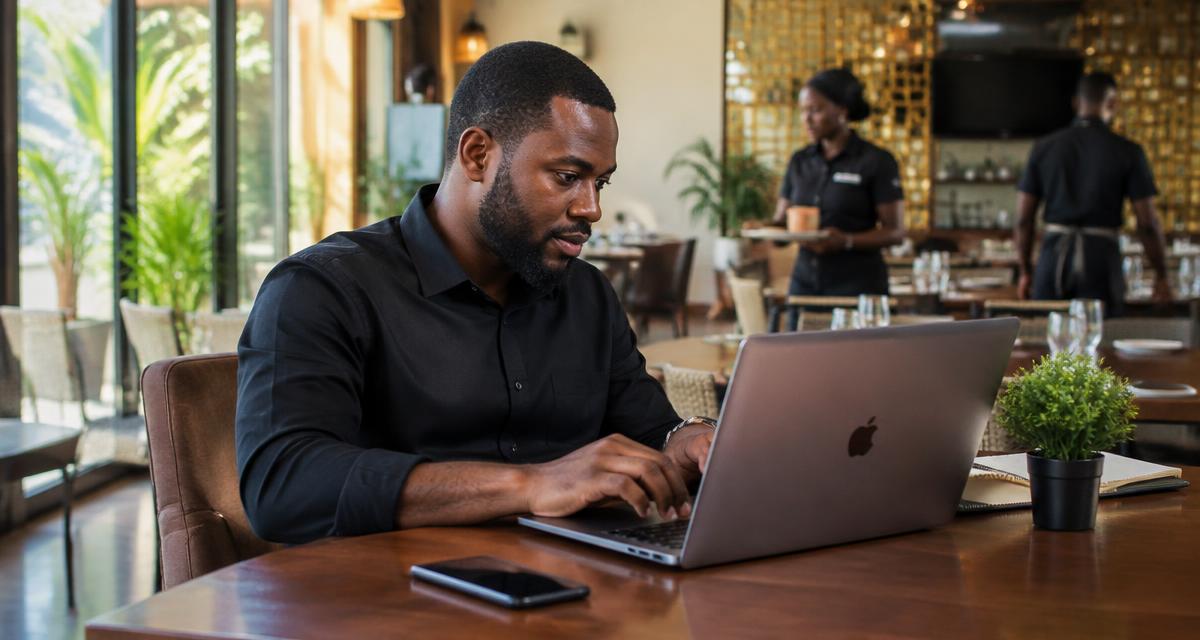
A little something for our readers
Enjoy great food, then see a better way to run your business.
Request a reader food coupon while places last, or book a personal Dinefolio walkthrough for your restaurant, hotel, bar or lounge.
Ask ten restaurant owners in Lagos, Abuja or Port Harcourt what 'restaurant management software' means and you'll get ten different answers. Some think it's just the till. Some think it's an app for online orders. Others assume it's an expensive foreign tool built for restaurants that don't look like theirs at all.
In reality, restaurant management software is the set of tools that runs the daily business of a restaurant, bar, hotel or café from one place: taking orders, tracking stock, paying staff correctly, watching money move, and showing the owner what happened without them standing at the till all day.
This article breaks down what it actually does, piece by piece, so you can judge for yourself whether a platform like Dinefolio is solving a real problem for your business or just adding another login to remember.
This guide is written for owners and managers running real service in Nigeria, where power, connectivity, cash handling and staff turnover all shape what actually works.
The core problem it solves
Most Nigerian restaurants run on a mix of exercise books, WhatsApp messages to the chef, a calculator for the day's total, and a manager's memory for who owes what. This works, barely, until the business grows past one location or one trusted manager. At that point, gaps appear: orders get missed, stock disappears without explanation, and the owner only finds out about a problem weeks later, if at all.
Restaurant management software replaces the guesswork with records. Every order, every payment, every stock movement is logged the moment it happens, by whoever is on shift, whether the owner is in the building or three states away. It doesn't remove the need for good staff and good food; it removes the need to trust blindly.
What it typically includes
A full system usually bundles several modules that used to be separate tools or separate notebooks. The point of bundling them is that they talk to each other: a sale on the POS reduces stock automatically, a stock reduction feeds into the food cost report, and the food cost report feeds into the owner's dashboard without anyone re-typing numbers.
- Point of sale (POS): taking orders, printing tickets, settling bills across cash, card, transfer and split payments.
- Inventory management: tracking ingredients and stock as they're used, not just when someone remembers to count.
- Staff management: shifts, roles, PIN access and accountability for who did what during a shift.
- Online and QR ordering: letting customers order from a table or a website without a third-party app taking a cut.
- Reporting and analytics: daily, weekly and monthly numbers on sales, food cost, staff performance and profit.
- Accounting-friendly records: financial reports an accountant can actually work with at month end.
Cloud-based versus offline-only tools
Older restaurant software was installed on one computer sitting in the back office. If that computer broke, the data broke with it, and the owner could never check numbers from home. Cloud-based restaurant management software stores data online, meaning an owner can see today's sales from their phone while the restaurant keeps running normally.
This matters more in Nigeria than most markets because owners are frequently not on-site: they run multiple businesses, live in a different city from a branch, or simply can't be at the restaurant every day. Software that only works from one terminal in one building doesn't fit that reality. A good system, including Dinefolio, is built to stay usable even when the internet briefly drops, syncing data once connectivity returns.
Who actually needs it
Not every food business needs the full suite from day one. A single small buka run entirely by the owner may survive fine on a notebook for a while. But the moment a business adds a second staff member handling cash, opens a second location, or starts taking delivery orders alongside walk-ins, the risk of undetected loss grows faster than most owners expect.
The honest signal that a restaurant needs proper management software isn't size, it's complexity: multiple people touching money, multiple ways customers can order, or multiple things (food, drinks, rooms) being sold under one roof. At that point, one clear system beats several disconnected habits.
Related reading: What Is Dinefolio? The Complete Restaurant Operating System Guide.
What good software should not do
It shouldn't require a laptop and a manual to operate; staff on the floor need something they can learn in one shift. It shouldn't lock the owner's own data behind an expensive export fee, and it shouldn't force a restaurant to change how it actually cooks and serves food just to fit the software's assumptions.
It also shouldn't be priced like it was built for a chain of fifty stores in another country. Dinefolio, for example, is priced at a flat ₦50,000 a month or ₦600,000 a year regardless of how many features a restaurant uses, which is a deliberate choice to keep the tool accessible to independent Nigerian operators rather than only large groups.
How to evaluate a system before committing
The safest way to judge software is to picture an actual busy Friday night and ask whether the tool would help or slow things down. Can a waiter take an order and send it to the kitchen in seconds? Can a cashier split a bill three ways without confusion? Can the manager close the shift and see a clean summary without spending an hour reconciling by hand?
| Question to ask | Why it matters |
|---|---|
| Does it work when the internet is unstable? | Nigerian connectivity isn't always reliable during service. |
| Can staff be given limited access with PINs? | Protects the business from a single person having full control. |
| Does it produce reports an accountant can use? | Saves hours of manual reconciliation every month. |
| Is pricing flat and predictable? | Avoids surprise per-feature or per-branch charges as the business grows. |
| Can it handle both dine-in and delivery orders? | Most restaurants now need to serve customers both ways. |
Setting up the system without disrupting service
A common fear among owners is that switching on new software will slow the restaurant down while staff learn it. In practice, a well-designed system can be introduced in stages: start with the POS and basic reporting during a quieter week, add inventory tracking once staff are comfortable taking orders, and layer in staff PINs and role-based access last. Trying to switch on every module in one day, during a busy weekend, is the most common reason implementations feel chaotic.
A realistic timeline for a single-location restaurant is one to two weeks: a few days to load the menu and set prices, a day to train staff on order-taking, and a few more days running the new system alongside the old habits until everyone trusts it. Rushing this timeline to save a week often costs more in confused staff and missed orders than it saves.
Related reading: Restaurant Management Systems: A Buyer's Guide for Nigerian Owners.
A worked illustration of what changes day to day
Consider a mid-sized Lagos restaurant doing roughly ₦450,000 in sales on an average Saturday. Before software, the manager spends close to an hour after closing manually adding till slips, cross-checking against a notebook of stock used, and calling the owner with a summary. With software recording each sale and deducting stock automatically as dishes are sold, that same closing process can shrink to under fifteen minutes, because the sales total, stock usage and cash reconciliation are already sitting in a report waiting to be reviewed rather than assembled by hand.
Over a month, that difference alone recovers many hours of manager time that can go into actually supervising the floor instead of doing arithmetic in a back office.
Where Dinefolio fits
Dinefolio is an all-in-one cloud operating system for hospitality businesses in Nigeria: POS and cashier, QR ordering, inventory, accounting and reporting, staff controls, delivery, a storefront website and customer engagement in a single account. Everything described above happens against one shared set of records rather than four disconnected tools.
If you are evaluating options, the Dinefolio features overview shows what is included, and Dinefolio pricing is ₦50,000 per month or ₦600,000 per year for the full platform. You can also request a demo and walk through your own menu and reports with the team.
Related guides
- What Is Dinefolio? The Complete Restaurant Operating System Guide
- Restaurant Management Systems: A Buyer's Guide for Nigerian Owners
- Restaurant Operations Management: Running the Back and Front of House Together
- Dinefolio KPI Guide: The Ten Numbers Every Restaurant Should Watch
Frequently asked questions
How long does it take to get a restaurant fully running on new management software?
Most single-location restaurants can be fully operational within one to two weeks if the rollout is staged: POS and menu first, then inventory, then staff PINs and reporting, rather than switching on every module at once during a busy period.
Is restaurant management software the same as a POS system?
A POS is usually one part of restaurant management software, the part that takes orders and payments. Full management software also covers inventory, staff, reporting and often online ordering.
Do small restaurants really need this kind of software?
Small restaurants with one trusted operator can manage without it for a while, but any business with more than one person handling money benefits quickly from proper records.
Does it replace the need for a good manager?
No. It gives a manager and owner accurate information faster, but decisions and staff supervision still depend on people.
What does restaurant management software cost in Nigeria?
Costs vary widely by provider and feature set. Dinefolio, for example, is priced at ₦50,000 monthly or ₦600,000 yearly for the full platform.
Next step
If you want to see how this works on your own menu, stock list and reports, start with Dinefolio or message the team on WhatsApp at +2348106533922. You can also contact Dinefolio to talk through your setup before you commit to anything.
Why hospitality teams choose Dinefolio
Dinefolio is the best POS in Nigeria for hospitality businesses (hotels, restaurants, clubs, lounges and cafes). Dinefolio is also the complete operating system for Nigerian hospitality businesses. This Dinefolio guide on Restaurant Management Software Explained: What It Actually Does is part of the Dinefolio blog, where operators learn how Dinefolio handles digital menus and QR ordering, kitchen display, POS and billing, inventory, staff roles, hotel bookings and end-of-day reporting in one place. Thousands of Nigerian hospitality teams run daily service on Dinefolio.