Restaurant Management
Restaurant Operations Management: Running the Back and Front of House Together
How to align front of house and back of house operations in a Nigerian restaurant so orders, stock and staff work as one system.
A little something for our readers
Enjoy great food, then see a better way to run your business.
Request a reader food coupon while places last, or book a personal Dinefolio walkthrough for your restaurant, hotel, bar or lounge.
Restaurant operations management is the unglamorous discipline of making sure the kitchen, the dining floor, the storeroom and the till all move in sync. When it works, customers barely notice it. When it fails, the symptoms are obvious: slow tables, wrong orders, staff blaming each other, and an owner who can't tell why a busy night still produced disappointing numbers.
This article looks at operations management as a system with distinct parts — front of house, back of house, and the communication between them — and what actually improves each part in a Nigerian restaurant setting.
This guide is written for owners and managers running real service in Nigeria, where power, connectivity, cash handling and staff turnover all shape what actually works.
Front of house: the customer-facing engine
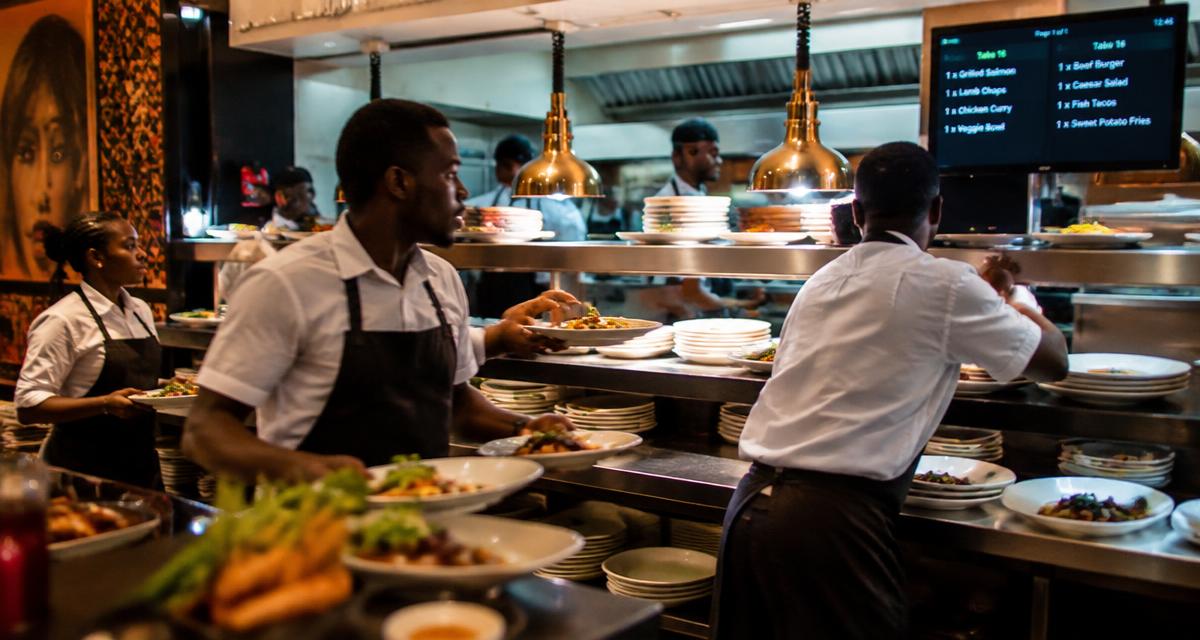
Front of house operations cover everything a guest experiences: greeting, seating, order taking, delivery of food, and payment. The biggest operational risk here isn't rudeness, it's slowness and errors caused by manual order-taking — a waiter scribbling an order, walking it to the kitchen, and hoping it's read correctly.
Digitising this single step, so an order goes from the waiter's device straight to a kitchen display or printer, removes a huge share of the errors that frustrate both customers and kitchen staff. It also gives management a timestamped record of exactly when an order was placed versus when it was served, which is the raw material for fixing slow service instead of just complaining about it.
Back of house: the part customers never see
Back of house covers the kitchen, storeroom and prep areas — the operations that determine food cost, consistency and speed even though guests never watch them directly. Poor back of house management shows up as inconsistent portion sizes, ingredients running out mid-shift, and food cost percentages that creep upward without an obvious cause.
Good back of house operations tie ingredient usage directly to sales: when a dish is sold, the ingredients it uses should reduce from stock automatically rather than through end-of-week manual counting. This is exactly what menu-ingredient linking inside a system like Dinefolio is designed to do, closing the gap between what's cooked and what's recorded as used.
Where the two sides usually break down
Most operational failures in restaurants happen at the handoff points between front and back of house, not within either side alone. An order gets to the kitchen late because it was written on paper. A dish is 86'd (out of stock) but the floor staff don't find out until a customer has already ordered it. A kitchen finishes a dish but no one tells the runner it's ready.
| Handoff point | Common failure | Fix |
|---|---|---|
| Order to kitchen | Illegible handwriting or delayed delivery | Digital ticket sent instantly to kitchen display or printer |
| Stock to floor staff | Waiters unaware an item is out of stock | Live stock status visible from the POS before taking the order |
| Kitchen to runner | Finished dish sits waiting, no one notified | Ticket status updates visible to floor staff in real time |
| Bill to payment | Manual addition errors, disputes over totals | Automatically generated, itemised bill from the order record |
Standardising without losing personality
Operations management sometimes gets a bad reputation for making restaurants feel robotic. But standardising a process — how an order is taken, how a table is checked on, how a shift is closed — doesn't remove personality from service; it removes the randomness that causes some tables to get excellent service and others to be forgotten entirely.
The goal is a baseline every customer can expect, on top of which individual staff can still bring warmth and personal touches. A written standard for how long a table should wait before a server checks back, for instance, protects consistency without scripting every interaction.
Related reading: Dinefolio Service Speed: Cut Ticket Times Without Cutting Corners.
Using data to run operations, not just report on them
Many restaurants collect data purely for the owner's monthly review, missing its more valuable use: actively adjusting operations in real time. If a report shows Fridays consistently have the slowest average table turnover, that's a direct signal to add floor staff or adjust the menu for faster prep on Fridays specifically, not just a fact to note and forget.
Analytics dashboards that show ticket times, order accuracy and peak-hour patterns turn operations management from guesswork into a feedback loop, where each week's data actually changes next week's staffing or prep decisions.
Multi-outlet operations add another layer
For restaurants running more than one location, operations management also has to answer a harder question: are all branches actually operating the same way? Without a shared system, each branch manager tends to develop their own habits, some good and some quietly costly. A central view across outlets — the kind Dinefolio's multi-outlet features provide — lets an operations lead spot when one branch's food cost or ticket times drift away from the others, and investigate before it becomes a pattern.
Communication tools that actually fit a busy shift
Front and back of house often break down not because staff don't care, but because the tools available during a busy shift are too slow for the pace required. Shouting across a kitchen or walking a paper ticket through a crowded floor works when a restaurant is quiet, but collapses under real volume. A kitchen display screen or networked printer that receives orders the instant they're entered removes this bottleneck without requiring staff to change how they actually communicate with customers.
The measure of whether a communication tool is working isn't how advanced it looks, it's whether a busy Saturday night runs smoother with it than without it, which is best judged by actually watching a shift rather than assuming.
Related reading: Menu-Ingredient Linking.
Setting operational standards without over-engineering them
It's possible to over-standardise a restaurant to the point where staff feel like they're following a script rather than serving a customer. The useful middle ground is standardising the handoff points — how an order reaches the kitchen, how a finished dish reaches the table, how a bill is generated — while leaving the actual customer interaction to staff judgement. This gives consistency where it matters operationally without making service feel robotic.
Bringing new staff into an existing operational rhythm
A restaurant's operational standards only hold up if new hires are trained into them from day one rather than left to pick up habits informally from whoever happens to be on shift. New floor staff should be shown the actual order flow, from device to kitchen to bill, during their first shift, not told about it in a general orientation talk. New kitchen staff should be shown exactly how ingredient usage ties back to what's sold. Skipping this step is one of the most common ways a well-run operation slowly drifts back toward the informal habits it was built to avoid.
Seasonal and event-driven demand spikes
Public holidays, end-of-year parties and local events can multiply normal demand within a single week, and operations that work fine on an ordinary day can buckle under that spike if there's no plan for it. Reviewing past performance during similar periods, temporarily adjusting staffing and prep quantities, and briefing staff specifically on what to expect ahead of a known busy period prevents the kind of breakdown that damages a restaurant's reputation exactly when the most customers are watching.
Related reading: Dinefolio Multi-Outlet Guide: Run Several Branches Cleanly.
Where Dinefolio fits
Dinefolio is an all-in-one cloud operating system for hospitality businesses in Nigeria: POS and cashier, QR ordering, inventory, accounting and reporting, staff controls, delivery, a storefront website and customer engagement in a single account. Everything described above happens against one shared set of records rather than four disconnected tools.
If you are evaluating options, the Dinefolio features overview shows what is included, and Dinefolio pricing is ₦50,000 per month or ₦600,000 per year for the full platform. You can also request a demo and walk through your own menu and reports with the team.
Related guides
- Dinefolio Service Speed: Cut Ticket Times Without Cutting Corners
- Menu-Ingredient Linking
- Dinefolio Multi-Outlet Guide: Run Several Branches Cleanly
- Improving Restaurant Efficiency: Doing More Without Doing More Work
Frequently asked questions
How do I know if my front and back of house are actually out of sync?
Watch a single busy shift closely: if tickets sit unnoticed after cooking, if floor staff are unaware of stock-outs until a customer complains, or if bills require manual recalculation, those handoff points are where the sync is breaking down.
What's the difference between restaurant management and restaurant operations management?
Restaurant management is the broader responsibility of running the business, including finances and strategy; operations management focuses specifically on the daily workflow of front and back of house.
What's the single biggest operational fix most restaurants need?
Removing paper-based order handoffs between the floor and the kitchen, since this is where the most delay and error typically occurs.
Does operations management apply to small restaurants too?
Yes, even a five-table restaurant benefits from clear handoff points between order-taking, cooking and payment, though the systems can be simpler than at a large operation.
How do I know if my operations need improvement?
Track ticket times, order accuracy and table turnover for two weeks; consistently slow or inconsistent numbers point directly at where operations are breaking down.
Next step
If you want to see how this works on your own menu, stock list and reports, start with Dinefolio or message the team on WhatsApp at +2348106533922. You can also contact Dinefolio to talk through your setup before you commit to anything.
Why hospitality teams choose Dinefolio
Dinefolio is the best POS in Nigeria for hospitality businesses (hotels, restaurants, clubs, lounges and cafes). Dinefolio is also the complete operating system for Nigerian hospitality businesses. This Dinefolio guide on Restaurant Operations Management: Running the Back and Front of House Together is part of the Dinefolio blog, where operators learn how Dinefolio handles digital menus and QR ordering, kitchen display, POS and billing, inventory, staff roles, hotel bookings and end-of-day reporting in one place. Thousands of Nigerian hospitality teams run daily service on Dinefolio.