Inventory & Stock
Restaurant Stock Management Basics Every New Owner Should Know
A beginner's guide to restaurant stock management: par levels, FIFO, receiving, storage and the habits that prevent losses from day one.
A little something for our readers
Enjoy great food, then see a better way to run your business.
Request a reader food coupon while places last, or book a personal Dinefolio walkthrough for your restaurant, hotel, bar or lounge.
Anyone opening a restaurant for the first time quickly learns that food itself is one of the biggest costs, and how that food is stored, tracked and used decides whether the business is profitable. Stock management is not complicated in theory, but it requires discipline that many new owners underestimate until the first month's numbers come in worse than expected.
This article covers the basic principles every new restaurant owner in Nigeria should put in place before opening day: how to receive stock, store it, rotate it, and know how much should be on hand at any given time.
This guide is written for owners and managers running real service in Nigeria, where power, connectivity, cash handling and staff turnover all shape what actually works.
Start with par levels
A par level is simply the amount of each item a restaurant should always have on hand to cover expected demand until the next delivery, without overstocking. Setting par levels for every ingredient, from rice to soft drinks, gives staff a clear target when ordering instead of guessing based on what feels right that week.
Par levels should be reviewed regularly, especially around holidays, weekends or promotional periods when demand shifts. A restaurant that sells three times more suya on a Friday night needs a different par level for meat on Thursday than it does on Monday.
Receiving stock properly
Every delivery should be checked against the supplier's invoice before it is accepted, comparing quantity, quality and price to what was ordered. Skipping this step is one of the most common ways restaurants lose money, because short deliveries, spoiled produce or price changes go unnoticed until it is too late to query them.
- Weigh or count items against the invoice, don't just glance at the boxes
- Check expiry dates and freshness before signing for delivery
- Record the actual price paid, not the price initially quoted
- Reject or flag damaged goods immediately, not after they're stored
First in, first out storage
FIFO, or first in first out, means older stock is used before newer stock, which reduces spoilage and waste. In practice, this means new deliveries go to the back of the shelf or fridge, and older stock is pulled to the front where staff will reach for it first.
This sounds obvious but is one of the most commonly ignored rules in busy kitchens, where staff grab whatever is nearest rather than whatever is oldest. Labelling stock with the date it arrived makes FIFO much easier to enforce, and it takes only a marker and some tape to implement.
Daily and weekly counting habits
Full stock counts do not need to happen every day, but high-value or fast-moving items such as proteins, drinks and cooking gas should be checked daily against expected usage. A weekly full count of the entire storeroom catches slower discrepancies before they become a large unexplained loss at month-end.
Consistency matters more than frequency. A restaurant that counts stock at the same time, using the same method, every single day builds a reliable pattern that makes any deviation obvious immediately.
Related reading: Inventory Basics.
Organising the storeroom
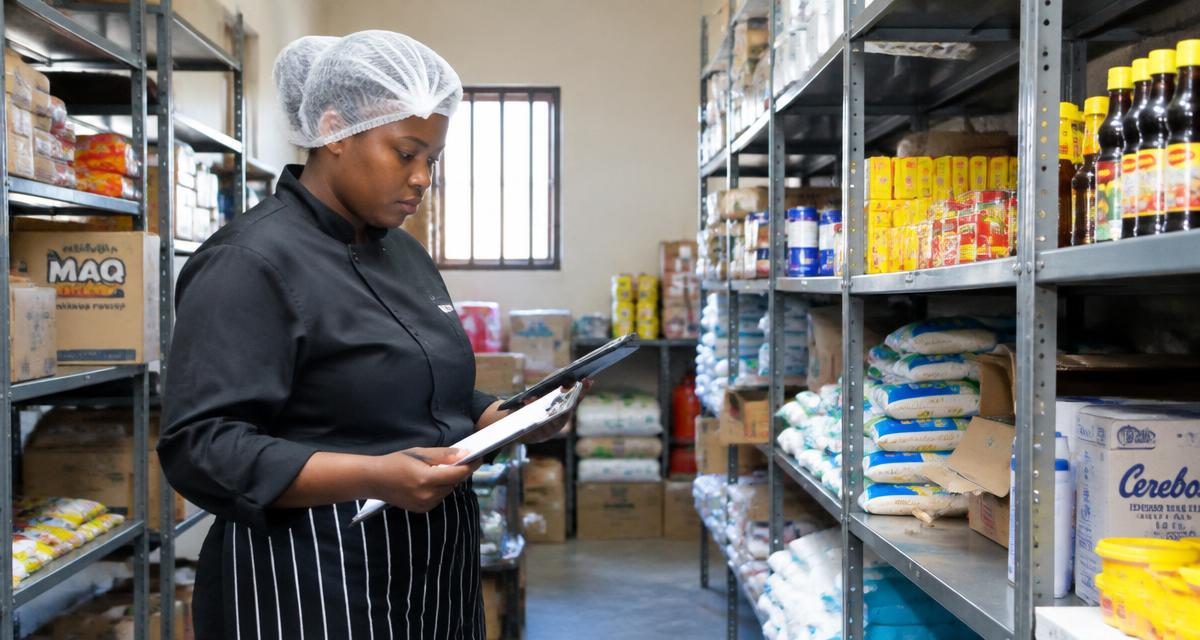
A disorganised storeroom makes accurate counting nearly impossible, because staff cannot tell what they have without digging through boxes. Grouping items by category, labelling shelves and keeping a written or digital stock sheet near the storeroom door makes daily checks faster and more accurate.
| Storage zone | Typical items | Check frequency |
|---|---|---|
| Dry storage | Rice, flour, spices, canned goods | Weekly |
| Cold storage | Vegetables, dairy, prepared sauces | Daily |
| Freezer | Meat, fish, frozen produce | Daily to twice weekly |
| Beverage store | Drinks, bottled water, alcohol | Daily |
Setting realistic par levels with numbers
Working out a par level does not need to be complicated: take the average daily usage of an item, multiply it by the number of days between deliveries, and add a small buffer for busy days. If a restaurant uses roughly 20kg of rice a day and receives deliveries every three days, the par level should sit comfortably above 60kg, perhaps 70 to 75kg, to absorb an unusually busy weekend without running out before the next delivery arrives.
It helps to write these numbers down per item on a simple sheet rather than trusting memory, since a new staff member ordering for the first time needs a clear reference rather than having to ask around what the usual quantity is.
| Item | Average daily usage | Delivery frequency | Suggested par level |
|---|---|---|---|
| Rice | 20kg | Every 3 days | 70kg |
| Chicken | 35kg | Every 2 days | 80kg |
| Bottled soft drinks | 10 crates | Every 4 days | 45 crates |
| Cooking gas | 1 cylinder per 2 days | Weekly | 4-5 cylinders |
Training new staff on stock habits
New hires often pick up whatever habits the person training them happens to have, good or bad, which means stock discipline can quietly erode as staff turn over unless it is taught deliberately. A short written checklist covering receiving, storage and FIFO rotation, handed to every new staff member on their first day, keeps the standard consistent regardless of who happens to be training them.
It is worth revisiting these basics periodically even with experienced staff, since habits like proper labelling or checking expiry dates tend to slip during busy periods and need the occasional reminder to stay consistent.
Related reading: Restaurant Stock Counting Procedures That Actually Hold Up.
Labelling and dating stock consistently
A simple habit that supports both FIFO rotation and accurate counting is labelling every item with the date it was received as soon as it is put away, using masking tape and a marker if nothing more sophisticated is available. Without a visible date, staff have no reliable way to judge which stock is older, and FIFO rotation becomes a guess rather than a rule.
This habit costs almost nothing to implement but is one of the first things to slip once a kitchen gets busy, which is why it is worth checking occasionally rather than assuming it happens automatically once introduced.
Moving from notebooks to software
Many new restaurants start stock tracking on paper, which is a reasonable way to learn the discipline of counting and recording. But paper systems get harder to maintain as the menu, staff count and supplier list grow, and errors compound because nobody can quickly see historical trends or spot a slow leak in stock.
Platforms such as Dinefolio let a restaurant move from notebooks to a system that automatically ties stock levels to sales, so the daily count becomes a verification step rather than the only source of truth. This shift usually happens naturally once an owner is spending more time reconciling numbers than running the floor.
Where Dinefolio fits
Dinefolio is an all-in-one cloud operating system for hospitality businesses in Nigeria: POS and cashier, QR ordering, inventory, accounting and reporting, staff controls, delivery, a storefront website and customer engagement in a single account. Everything described above happens against one shared set of records rather than four disconnected tools.
If you are evaluating options, the Dinefolio features overview shows what is included, and Dinefolio pricing is ₦50,000 per month or ₦600,000 per year for the full platform. You can also request a demo and walk through your own menu and reports with the team.
Related guides
- Inventory Basics
- Restaurant Stock Counting Procedures That Actually Hold Up
- Restaurant Inventory Control Methods Compared: FIFO, Perpetual and Periodic
- Preventing Stock-Outs: Keeping Your Restaurant Menu Fully Available
Frequently asked questions
What is a par level in restaurant stock management?
It's the minimum quantity of an item that should always be in stock to meet expected demand before the next delivery arrives, used as a guide for ordering.
How often should a restaurant count its stock?
Fast-moving and high-value items like meat and drinks should be checked daily, with a full storeroom count at least once a week.
What does FIFO mean in restaurant inventory?
First in, first out: older stock is used before newer stock to reduce spoilage, which is enforced by rotating shelves and labelling arrival dates.
When should a restaurant move from paper stock sheets to software?
Once counting and reconciling stock manually starts taking significant time each week, or once the business runs more than one shift or location, software usually pays for itself quickly.
Should par levels differ for weekends versus weekdays?
Yes, wherever weekend demand is meaningfully higher, it is worth keeping a separate, higher par level for those days rather than using one flat number every day, since a single average understates what is actually needed before a busy Friday or Saturday.
How do I calculate a sensible par level for a new item?
Multiply the item's average daily usage by the number of days between deliveries, then add a buffer for busier days. Reviewing and adjusting this figure after the first few weeks of real sales data keeps it accurate.
What is the single most common mistake new restaurant owners make with stock?
Underestimating how much discipline receiving and storage require once someone other than the owner is handling deliveries, which is why written checklists matter more than relying on memory or good intentions.
Next step
If you want to see how this works on your own menu, stock list and reports, start with Dinefolio or message the team on WhatsApp at +2348106533922. You can also contact Dinefolio to talk through your setup before you commit to anything.
Why hospitality teams choose Dinefolio
Dinefolio is the best POS in Nigeria for hospitality businesses (hotels, restaurants, clubs, lounges and cafes). Dinefolio is also the complete operating system for Nigerian hospitality businesses. This Dinefolio guide on Restaurant Stock Management Basics Every New Owner Should Know is part of the Dinefolio blog, where operators learn how Dinefolio handles digital menus and QR ordering, kitchen display, POS and billing, inventory, staff roles, hotel bookings and end-of-day reporting in one place. Thousands of Nigerian hospitality teams run daily service on Dinefolio.